The Blue-Haired Fairy Revives Pinocchio and Punishes His Lies
Pinocchio (Tania Zamorsky Edition)The Blue-Haired Fairy’s rescue of Pinocchio turns a scene of apparent death into a lesson about care, fear, and honesty. She brings the hanged puppet into her home and nurses him through a fever; when his account of the attack gives way to lies about his coins, his growing nose makes deception physically impossible to conceal. The episode joins rescue to correction: the Fairy saves Pinocchio, but does not spare him the consequences of his choices.
Rescue and the Question of Life
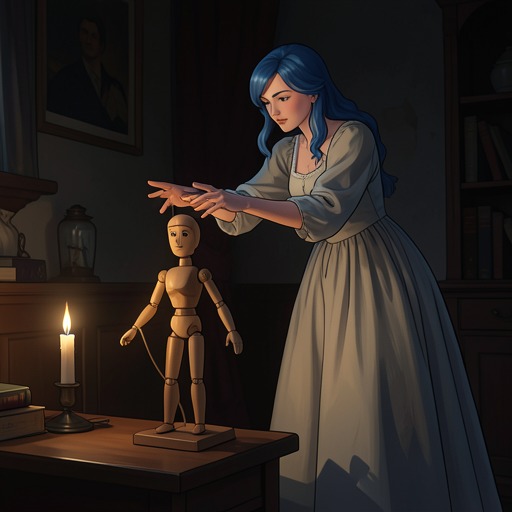
Pinocchio is hanging by the neck from a branch of the Great Oak, nearly more dead than alive, when the Blue-Haired Fairy appears at her window. Moved by the sight of him swaying in the north wind, she claps her hands three times and gives three small knocks. A large falcon flies to the window, where it bows reverently. The Fairy points out the puppet hanging from the tree, setting the rescue in motion.
The Fairy is not merely a mysterious girl in the house nearby: she is a good Fairy who has lived in the neighborhood of the forest for more than a thousand years. After a brief interval, a coach returns, drawn by a hundred pairs of white mice. Its sky-colored body is padded with canary feathers, and its interior is lined with whipped cream and cream with ladyfingers. Waiting at the door, the Fairy takes Pinocchio in her arms and carries him to a small room with mother-of-pearl walls.
She summons the most celebrated doctors nearby to decide whether Pinocchio is alive or dead. A Raven, an Owl, and a Talking Cricket gather around his bed. The Raven examines his pulse, nose, and little toe before giving a verdict that contradicts itself: Pinocchio is dead, unless he is alive, in which case that proves he is still alive. The Owl objects to the Raven’s interpretation of a dead patient’s tears, proposing instead that they show how unwilling the patient is to die. Their solemn professional debate offers little certainty, while Pinocchio’s tears make his fear plain.
Medicine, Fear, and Pinocchio’s Account
Once the doctors have left, the Fairy touches Pinocchio’s forehead and recognizes that he has a severe fever. She dissolves a white powder in half a glass of water and offers it as medicine. Pinocchio would rather die than drink something so unpleasant. He eats the sugar but refuses the purgative, and the Fairy warns him that medicine taken in time can prevent grave illness or even death.
His refusal becomes harder to maintain when four black rabbits enter carrying a small coffin on their shoulders. They explain that Pinocchio has only minutes to live because he rejected the medicine that could have cured his fever. He sits upright in alarm and begs the Fairy to give him the glass. Taking it in both hands, he drains it at once. The rabbits leave with their coffin, grumbling that their journey has been wasted. Pinocchio promises that next time he will remember the black rabbits and take medicine without such resistance; the imagined approach of death has accomplished what the Fairy’s warning alone could not.
The Fairy then asks how Pinocchio came into the hands of the assassins. He recounts that Mangiafoco gave him gold coins to take to his father, but that he followed the Fox and the Cat after they promised to multiply the money at the Field of Miracles. At the Red Lobster Inn, he says, the pair disappeared while he slept. On his night journey he met two assassins, hid the four coins in his mouth, and bit one attacker’s hand; when he spat it out, it had become a cat’s paw. The assassins pursued him and hanged him from a tree, intending to return for the coins.
The Lies Made Visible
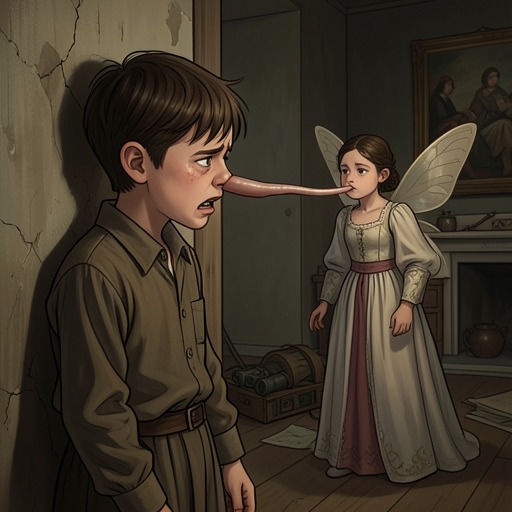
When the Fairy asks where the four coins are now, Pinocchio says he has lost them, although they are in his pocket. His nose immediately grows by two fingers’ breadth. Asked where he lost them, he says in the nearby forest, and it grows again. The Fairy replies that anything lost in that forest can be found. Pinocchio changes his story once more, claiming that he swallowed the coins while drinking the medicine. This third lie makes his nose grow so enormously that he can scarcely turn his head.
The growth converts an invisible falsehood into an obstacle that occupies the room. If Pinocchio turns one way, his nose strikes the bed or the windowpanes; if he turns the other, it hits the walls or the door. Raising his head risks poking the Fairy in the eye. He tries to escape, but the nose no longer fits through the doorway. His body gives away what his words attempt to hide, and the lie traps him in the very room where he has been rescued.
The Fairy watches and laughs as Pinocchio becomes confused and ashamed. She lets him cry and shout for half an hour, not because she has abandoned him, but to give him a severe lesson about lying. The delay makes the consequence last: rescue does not immediately erase the harm of his conduct. When she sees that he is in great distress, however, pity changes the course of the punishment.
Correction and Renewed Affection
At the Fairy’s signal, a thousand large woodpeckers enter through the window and settle on Pinocchio’s nose. They peck at it until, within minutes, it has been reduced to its natural size. The Fairy’s intervention is both a remedy and an unmistakable contrast with the earlier scene: the same household that used urgent medicine to save Pinocchio now uses an almost fantastical flock of birds to undo the bodily mark of his lies.
Pinocchio thanks the Fairy and tells her how much he loves her. She returns his affection and offers him a place beside her as her little brother if he will stay, promising to be his good little sister. The episode therefore ends not with the punishment alone, but with a proposed bond of care. The Fairy’s compassion has limits and consequences, yet it also provides Pinocchio with a place to remain after the danger, the fever, and the shame have passed.